The first installment in Worship Leader Research’s behind-the-scenes look at the worship music industry indicated the 2010s were marked by Big 4 songwriters (from Hillsong, Bethel, Elevation, and Passion) largely operating in separate silos. Despite public language about a worship music “family,” the data told a different origin story. While the Big 4 did engage in co-writing, these collaborations were typically confined within their groups. Though a professional songwriter was sometimes brought in, the frequency of this varied by group. But in the years since, something has shifted. In the 2020s so far, the Big 4 silos have been replaced by a family of songwriters. What was once a field organized and dominated by institutions is now a group of specific people connected to one another regardless of their current or former affiliations.
The 2020s Songwriting Family

From 2020 to 2025, 51 new songs emerged on the CCLI Top 100 lists written by 100 different songwriters. With more than twice as many writers as songs, it’s clear that collaboration remains an important part of the process of writing new songs. However, co-writing has now become the only way to write a Top 100 song.
In the 2010s, nine new songs were written by a solo songwriter. But in the 2020s, at least so far, that number has dropped to zero. While data shows a trend away from solo songwriting over the past two decades, collaboration is now unquestionably a constant across all the new popular songs of the 2020s.

The Unaffiliated Boom
Based on the CCLI Top 100 lists from 2020-2025, a shift away from “affiliated” writing has benefited solo artists who are not members of the Big 4 collectives. Solo songwriter/artist were present in the 2010s, but their share of the new CCLI Top 100 songs is now significantly larger. Two writers in particular have credits on numerous songs—Phil Wickham and Brandon Lake.
Phil Wickham (signed with Fair Trade Services) stands out, not only for his ten new song credits on the 2020s charts, but also for his tendency to write with nearly everyone. Wickham was present in the 2010s, but his prominence grew significantly as he collaborated across the Big 4. His comment at the 2022 GMA Dove Awards resonates more than ever: “C’mon. It’s just a family.” (View Video) And, as a solo writer/artist who occasionally collaborated in the 2010s, this statement from him is unsurprising in a new world where people like Wickham have finally superseded their affiliations.
While Wickham is a carry-over from the 2010s, Lake is the front-liner of the 2020s, staggeringly credited with 13 of the 51 most-sung songs. Brandon Lake is the co-writer of one in every four songs written so far in the 2020s. Originally affiliated with Bethel (signed in 2019), Lake now releases music with Provident (since 2022), a Sony Entertainment label.
Brandon Lake’s influence extends beyond his prolific output, and his rise to prominence is worthy of exploration. Like Wickham, Lake doesn’t anchor himself to a single church or label. He moves freely across networks, co-writing with Elevation, Maverick City, Wickham, Sons of Sunday (a new supergroup of male artists from these circles), and even mainstream names like Jelly Roll . For now, he seems to be the favorite uncle at family gatherings, a familiar presence wherever worship music is being written.
This collaborative model reflects Wickham’s description of the 2020s songwriting culture as the rise of a songwriting family. No longer limited to church collectives or label teams, these are now primarily relational networks of co-writers and artists whose names appear together across songs and projects. The visual web no longer shows clean lines between Big 4 silos but rather an interconnected family tapestry, and the central thread links Lake to nearly every major group.
The Rise of Inter-Church Collaborations
The fact that there are more writers than songs obviously points to collaboration. Our visualizations in this article highlight the extent of cross-artist partnerships, shown by the numerous intersecting lines and varied color affiliations. The visualization illustrates shifts in the prominence of specific groups from the 2010s to the present.
Since this article focuses on songwriters and not the state of the Big 4, we will only briefly name how the prevalence of the songwriters affiliated with the Big 4 has changed. With the rise of solo artists and this interconnected family, we see more lines across color groups rather than within them. A comparison to the 2010s shows a significant swing in the share of songwriters affiliated with the Big 4. In the 2020s, Passion, Hillsong, and Bethel have significantly fewer songwriters in the mix than the previous decade.
Since 2020, the most prominent songwriting contributors to top worship songs from the Big 4 have come from Elevation Church. Chris Brown (nine songs) and Steven Furtick (12 songs) hold the most songwriting credits. Meanwhile, a new wave of influential songwriters has emerged from non-church-based bands, most notably Maverick City Music. The popularity of the Old Church Basement (2021) collaboration between Maverick City Music and Elevation Worship helped introduce Chandler Moore (three songs) and Dante Bowe (five songs). Chandler has continued to collaborate with Elevation, and Bowe continues to collaborate with Bethel Music (Bowe was formerly signed with Bethel Music and is no longer affiliated with Maverick City Music).
The arrival of Maverick City as a “new member” of the worship music family has expanded the network of songwriting connections in the 2020s. The prevalance of collaborations with songwriters from this new group further emphasizes the breakdown of the institutional silos and the focus on inclusion of people and family collaborations.
Where Did the Career Writers Go?
With institutional influence waning, we see some shifts in the role of career songwriters. The influence of figures like Jason Ingram and Jonas Myrin (major players in the 2010s) on CCLI charts has notably declined. In our previous article, we noted that eight key professional songwriters (defined by a minimum of three songs) were credited on 30% of all newly written songs between 2010-2019. In the 2020s so far, only six of them have a songwriting credit across just 11 songs (22%).
Only one career songwriter remains prominent from the 2010s, and there are only two career songwriters/producers who have at least three songwriting credits. Jonathan Smith is credited on six songs, and Mitch Wong has six credits. Jonathan Smith is the only career songwriter to have 3+ songs in both the 2010s and the 2020s. The presence of the most prominent career writers from the 2010s has decreased by 8% since the beginning of the new decade. At the same time, a larger percentage of top songs now include a career songwriter (53%), meaning more career songwriters are involved but with fewer songwriting credits each.
Some career songwriters of the 2010s may have fewer credits due to fewer releases in the 2020s from the songwriters and churches with whom they primarily collaborated. For example, Myrin wrote many songs with Hillsong and Matt Redman. On the other hand, Ingram wrote many songs with every member of the Big 4, and his name doesn’t even break the minimum for the diagram. So even though Myrin and Ingram were prominent writers in the 2010s, the people with whom they wrote are not as prominent in the 2020s, leading to fewer credits.
All Sons of Sunday And No Daughters
A final major trend worth noting is the absence of women. So far in this article, the only writers discussed have been men. While men have been the primary writers of the CCLI Top 100 songs, this does not mean that women can’t have a meaningful voice or skill in songwriting. Yet, the overwhelming presence of male songwriters has far outnumbered the women in the songwriting family. The rarity of women in songwriting rooms, however, is not a new phenomenon.
In the 2010s, three women (Brooke Ligertwood, Jenn Johnson, and Mia Fieldes) were credited on three or more songs. In the 2020s so far, only one woman, Brooke Ligertwood, is credited on three songs, and she is the only remaining woman from the 2010s list.
The presence of women in writers’ rooms has increased over the last few decades; however, women remain underrepresented. They are present in less than 50% of the rooms where the most popular songs are written.
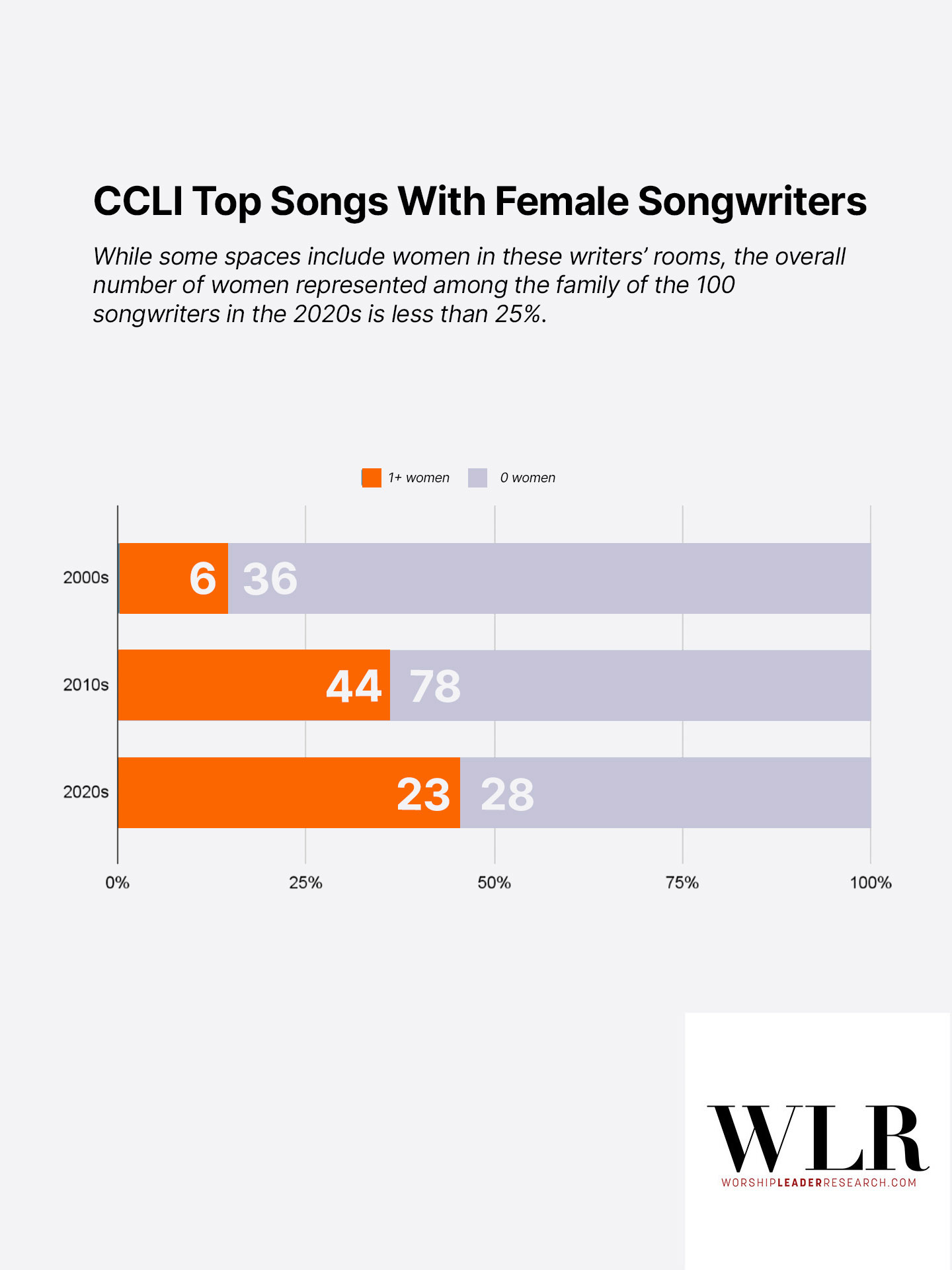
While some spaces have included women in these writers’ rooms, the overall number of women represented among the family of the 100 songwriters in the 2020s is less than 25%.
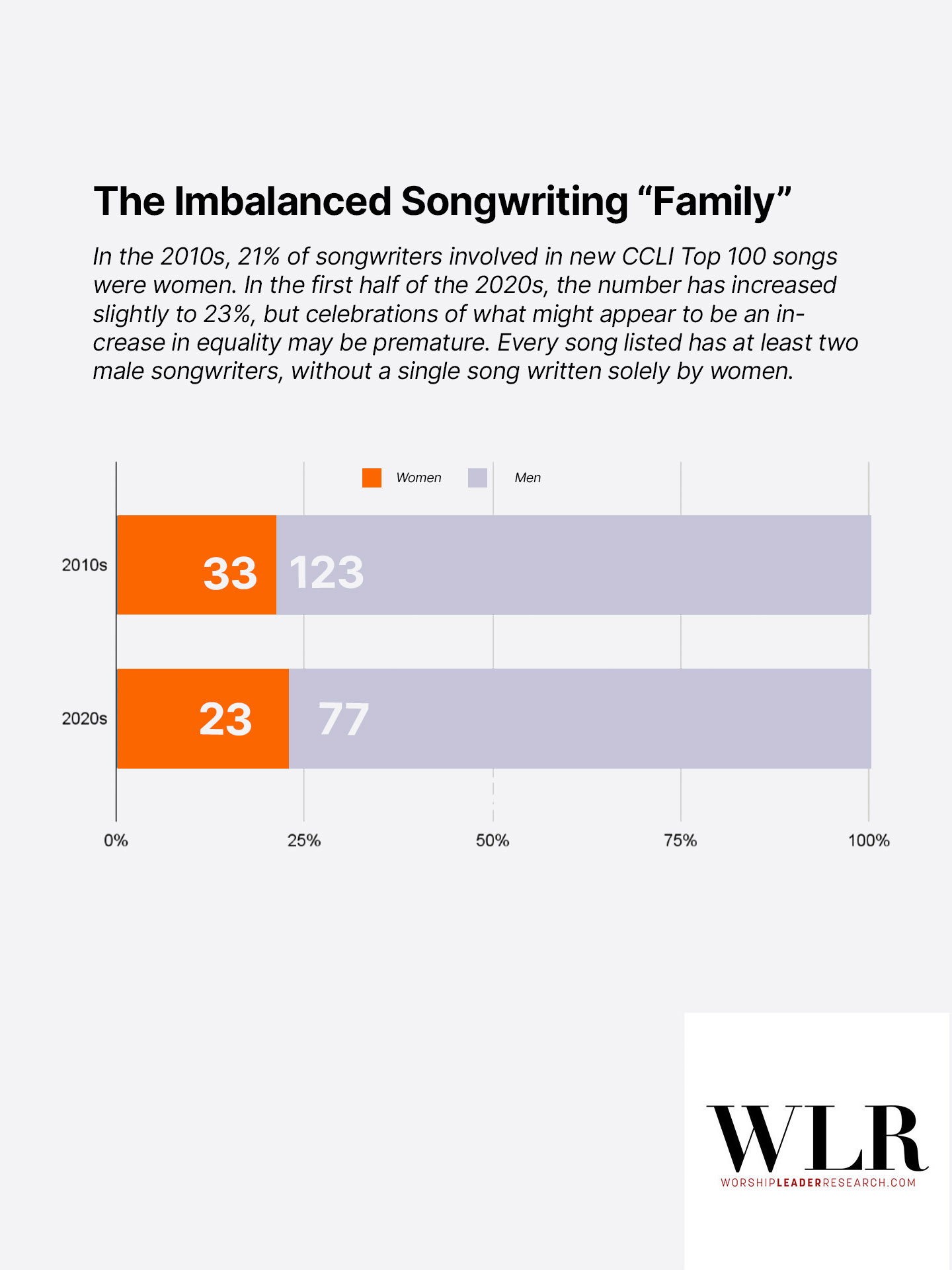
In this male-dominated context, a recently formed (late 2024) artist collective stands out: Sons of Sunday, comprising many prominent writers featured in our visualization, including Steven Furtick, Brandon Lake, Chandler Moore, Chris Brown, Leeland Mooring, and Pat Barrett. While not yet a household brand, the name alone reflects the family nature of the worship songwriting industry. It also highlights the notable absence of women from these groups.
At Worship Leader Research, we believe it’s essential to shed light on aspects of the worship music industry that many worship leaders may not be aware of. Our behind-the-scenes mini-series has taken a closer look at the people who write songs, how they reach local churches, and how songwriters and their publishers are compensated. Although this article concludes our mini-series, our next publications will continue to explore various aspects of the music industry, provide insights for worship leaders, and engage with worship leaders’ thoughts about their role in the church.