How Elevation Survived—and What the 2020s Say About the Future of Worship Music
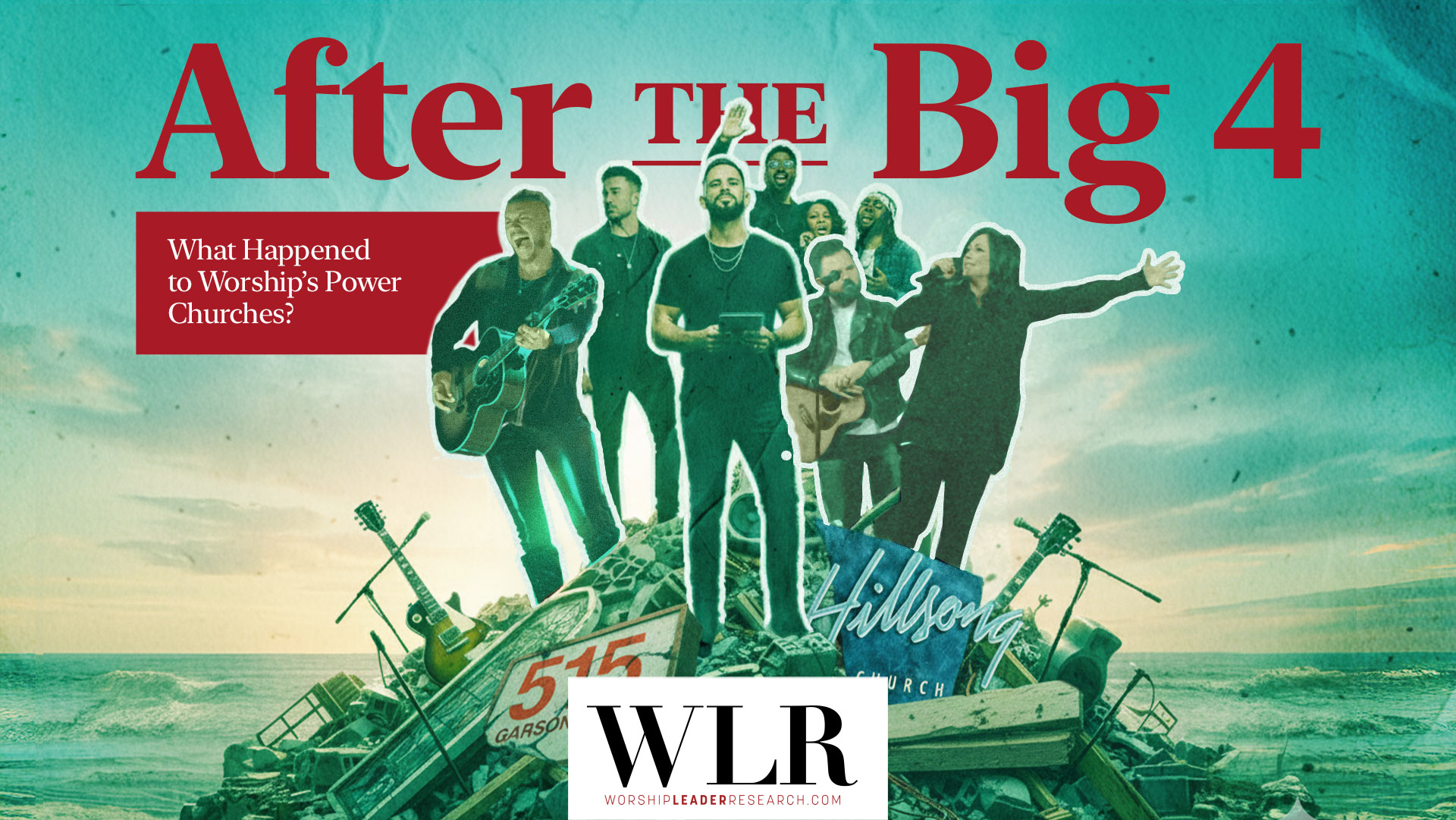
Two and a half years ago, Worship Leader Research released our first major article, which helped give language to what many worship leaders intuitively sensed but hadn’t fully articulated: namely, throughout the 2010s, a small handful of megachurches – Bethel, Elevation, Hillsong, and Passion – had dominated the relevant charts. We dubbed them the “Big 4.” If worship leaders were leading with the latest “top songs” in the 2010s, they were almost certainly doing so with ties to these four worship music powerhouses.
When this groundbreaking study landed in 2023, though, we were already well into the 2020s, and understandably, a lot of readers wanted a more up-to-date lay of the land. Here at the midway point of the decade, our last article traced things from a songwriting perspective. This new article asks a different question: Who are the “artists,” “performers,” or “popularizers” (yes, we know these terms are loaded) of the most common new songs we’re singing so far this decade?
Revisiting The 2010s
If you want to know how we arrived at the list we have, you can find the methodology for our original study of the 2010s here. Back in 2023, when WLR launched, the headline that prompted significant responses across the church was quite straightforward: Nearly 100% of the 2010s Top 25 worship songs traced back to four megachurches, either Bethel, Elevation, Hillsong, or Passion. It was the very definition of a tightly knit worship music ecosystem.
Mid-2020s Check-In
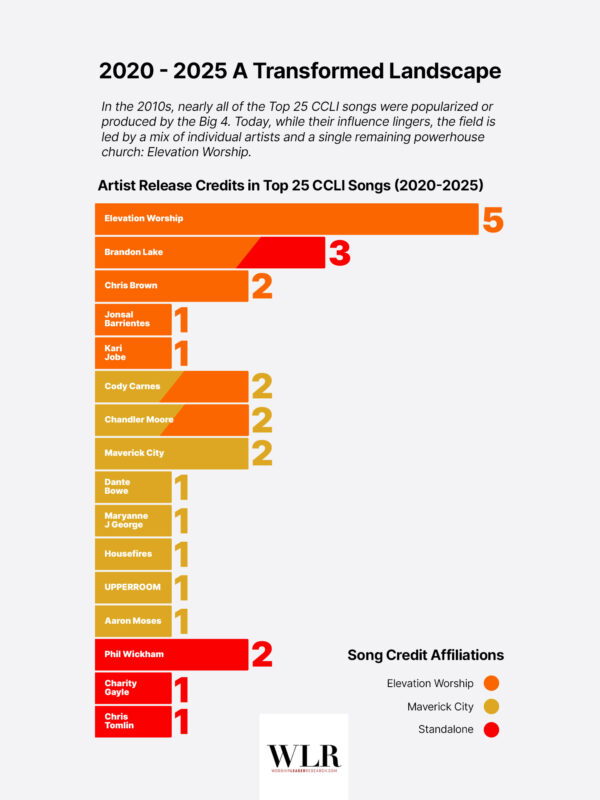
Applying the same criteria we used for the 2010s (namely songs that were both written and released within the current decade), we now ask, “What does this breakdown look like halfway through the 2020s?”
Perhaps the most striking thing to notice is that only one member of the previously prominent Big 4 megachurches seems to have maintained any presence on this list: Elevation. In fact, by the midpoint of the 2020s, Elevation has already matched its entire Top 25 count (5) from the 2010s. This signals not only longevity, but momentum. Influential voices are noting this, too. For example, this recent Instagram reel from Jackie Hill Perry (seemingly referencing our previous work) encapsulates this, since the one church she names is Elevation. So, where have the other three worship music powerhouses gone?
Where’d the Others Go?
Hillsong
One could argue that leadership scandals and the departure of core songwriters have impacted the Hillsong brand and dampened confidence among churches that once championed their music, to the degree that they have not released anything official since 2022.
Passion
Once fueled by the songwriting of Chris Tomlin and Matt Redman, it might be said that Passion’s creative pipeline has thinned as Passion artists have increasingly shifted focus, leaving the movement with a smaller chart footprint.
Bethel
Still releasing music that’s landing in the Top 100 and led by voices like Josh Baldwin, Bethel’s stream of Top 25 songs, so predominant in the 2010s, has also waned.1Bethel released a version of “Holy Forever” over 6 months after Chris Tomlin’s, which narrowly preceded the song’s entry into the CCLI Top 100. However, looking at Praise Charts & YouTube analytics, it seems safe to assert that public consciousness about the song is that it retains identity primarily as a Chris Tomlin song. While further study is needed for certainty, it’s plausible that Bethel’s public practices, combined with online detractors, have reduced the church’s perceived credibility in the broader North American church.
Of course, these stories need not be told by way of “downfall” or “failure.” Perhaps a better way to frame them is with the word “displacement.” The center of gravity in new worship music seems to have migrated from a few megachurch hubs to a wider mix of individual artists and emerging collectives.
The Rise of the Individuals (and Individual Collectives)
As WLR has recently shown, the 2020s have so far seen the rise of solo worship artists. Brandon Lake has 3 songs, and Cody Carnes and perennial favorite Phil Wickham each appear multiple times in the Top 25. All 3 have spent time leading on the stages of the Big 4, and while some of their 2020s releases remain tied to those platforms, their current success suggests these writers are less reliant on megachurch platforms to authenticate their songs for congregational use.
Charity Gayle’s “I Speak Jesus” stands out as a surprise Top 25 song in the 2020s because it carries no formal ties to any particular megachurch brand. Whether that independence is a rare exception or an early sign of a broader trend remains to be seen.
Meanwhile, Maverick City Music (an artist collective which has, over time, featured a wide array of talent like Chandler Moore, Dante Bowe, and Maryanne J. George) offers a stronger case for that shift away from church-based platforms. Although they clearly began the decade by closely collaborating with churches, including Elevation, Maverick City has since moved beyond those affiliations. Today, they release congregational worship music that gains wide adoption without the covering of the identity of any particular church.2 News recently emerged about the departure of Maverick City’s key members, Chandler Moore and Naomi Raine, with producer Norman Gyamfi reportedly involved. While the impact on Maverick City’s mainstream reach remains unclear, Gyamfi’s recent interview offers insight into the group’s strategic marketing approach.
Elevation
As highlighted above, Elevation’s sustained momentum into the 2020s is unmistakable. Songs such as “Graves into Gardens,” “RATTLE!” and “Same God,” led by prominent voices like Chris Brown, Jonsal Barrientes, and Tiffany Hudson, have kept Elevation firmly in the congregational mainstream and on major streaming playlists in the first half of the current decade.
Elevation seems to have recognized the winds of change toward individualized worship artists. This is evidenced in how they increasingly credit their own songs. Since their successful 2021 collaborative album, “Old Church Basement” with Maverick City, Elevation has credited featured artists on their songs, even when those voices (like Chris Brown, Jonsal Barrientes, and Tiffany Hudson) are already firmly associated with the “Elevation brand.”
Anomalies
Data often reveals trends that are interesting to observe and discuss, but it also serves up curious anomalies. It’s hard to say, for example, why the song “Worthy Of It All” (written in 2012) abruptly entered the Top 100 in June 2022 (entering at 65) and then cracked the Top 25 in December 2023. CeCe Winans’ 2021 version of the song may have boosted it, but that hardly explains the song’s long and winding path toward widespread adoption. Songs have stories and, sometimes, those stories defy a neat and tidy timeline.
Why it All Matters
This shift from Big 4 anchored influence to artist-driven worship brands raises some important questions for pastors, worship leaders, worship studies scholars, and the industry itself:
- How will worship leaders discern which songs to trust when the “local church” is no longer the default gatekeeper?
- What happens to licensing and reporting when the primary drivers are individuals or loosely affiliated collectives?
- Does the “celebrity worship artist” dynamic change how congregations experience the act of worship?
These aren’t abstract musings. They shape how songs are introduced, licensed, and sustained in the life of the church (And yes, we’re watching disruptors like Multitracks’ alternative-licensing model, which could further loosen CCLI’s monopoly). At WLR, our mission is to shed light on the complicated relationships between worship leaders and songwriters, between worship artists and local congregations. These relationships both validate and complicate our understanding of the songs themselves. The 2020s are still rewriting the rules. In the second half of the 2020s, the question won’t just be which songs the Church will sing next, but also who gets to decide what those songs will be (and who is seeking to influence those decisions).