Today’s Worship Leaders may not be quite who you think they are.
Picture the typical worship leader. You’re probably imagining someone young, artsy, and fashionable. Maybe you picture them sporting hipster glasses and skinny jeans, with a carefully curated Instagram aesthetic.
You’d only be partly right.
Worship Leader Research (WLR) recently completed the largest survey of worship leaders ever conducted in North America, with over 3,600 participants across the U.S. and Canada.1 Our sampling method was a convenience survey distributed through our email list, the WLR social media networks, and an extended circle of colleagues including: worship professors, social media accounts,prominent worship leaders, and others who write publicly about worship music. The data from our survey is not weighted to match national averages of churches or leaders, unlike some larger national surveys. For the first time, we can move beyond anecdotes and stereotypes and see who these influential leaders actually are. The data reveals some genuinely surprising patterns.
Brandon Lake’s “Bubba” sparked some controversy about the nature of worship songs and the identity of the average worshiper. In worship studies, we’re familiar with attempts at composite portraits that are locally and globally relevant through monikers like the radio business’s “Becky,” Pastor Rick Warren’s “Saddleback Sam” in the 1990s, or Catholic liturgical scholar Aiden Kavanagh’s “Mrs. Murphy.” But the leaders of worship have not been treated with such alliterative attention.
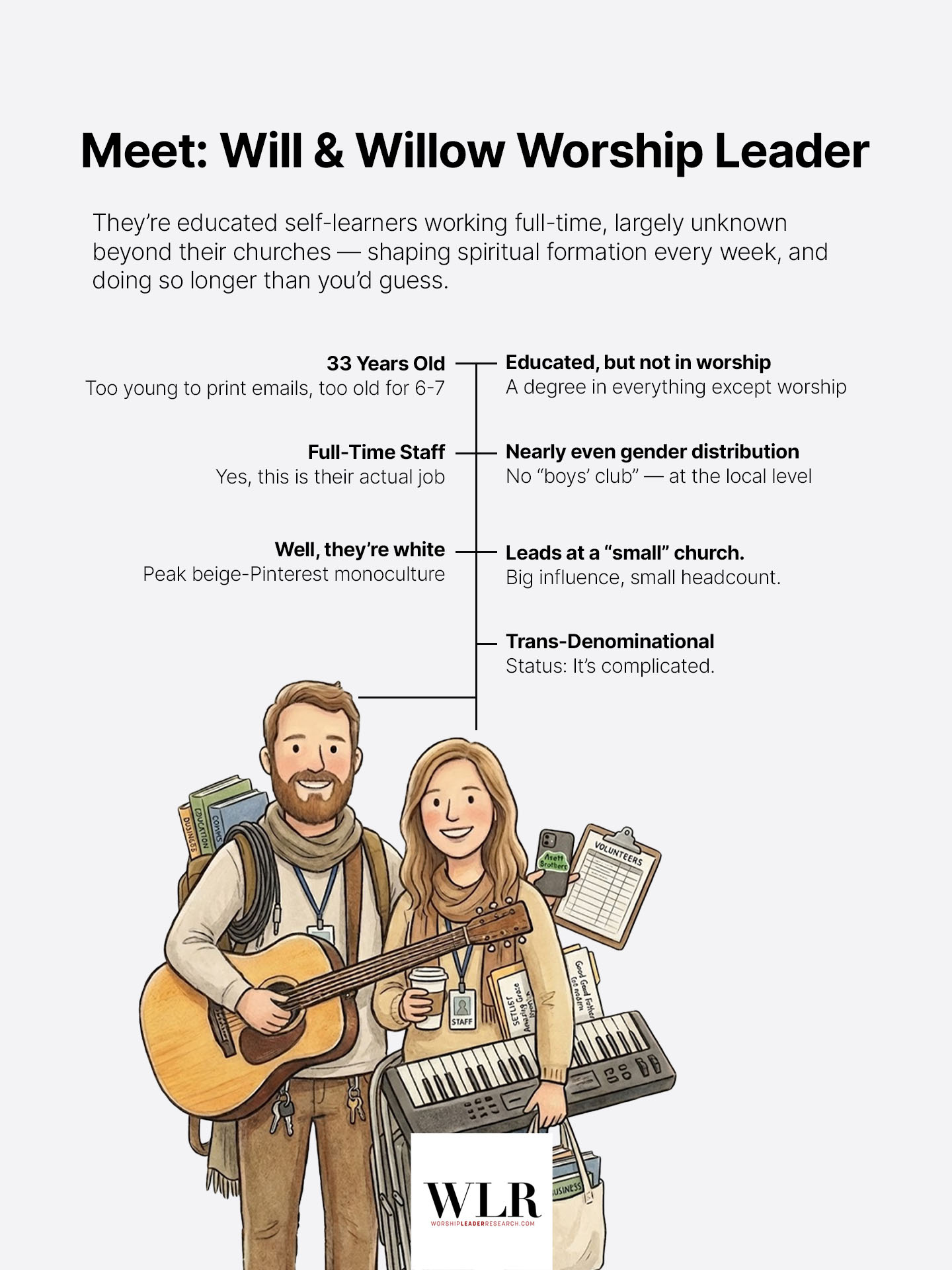
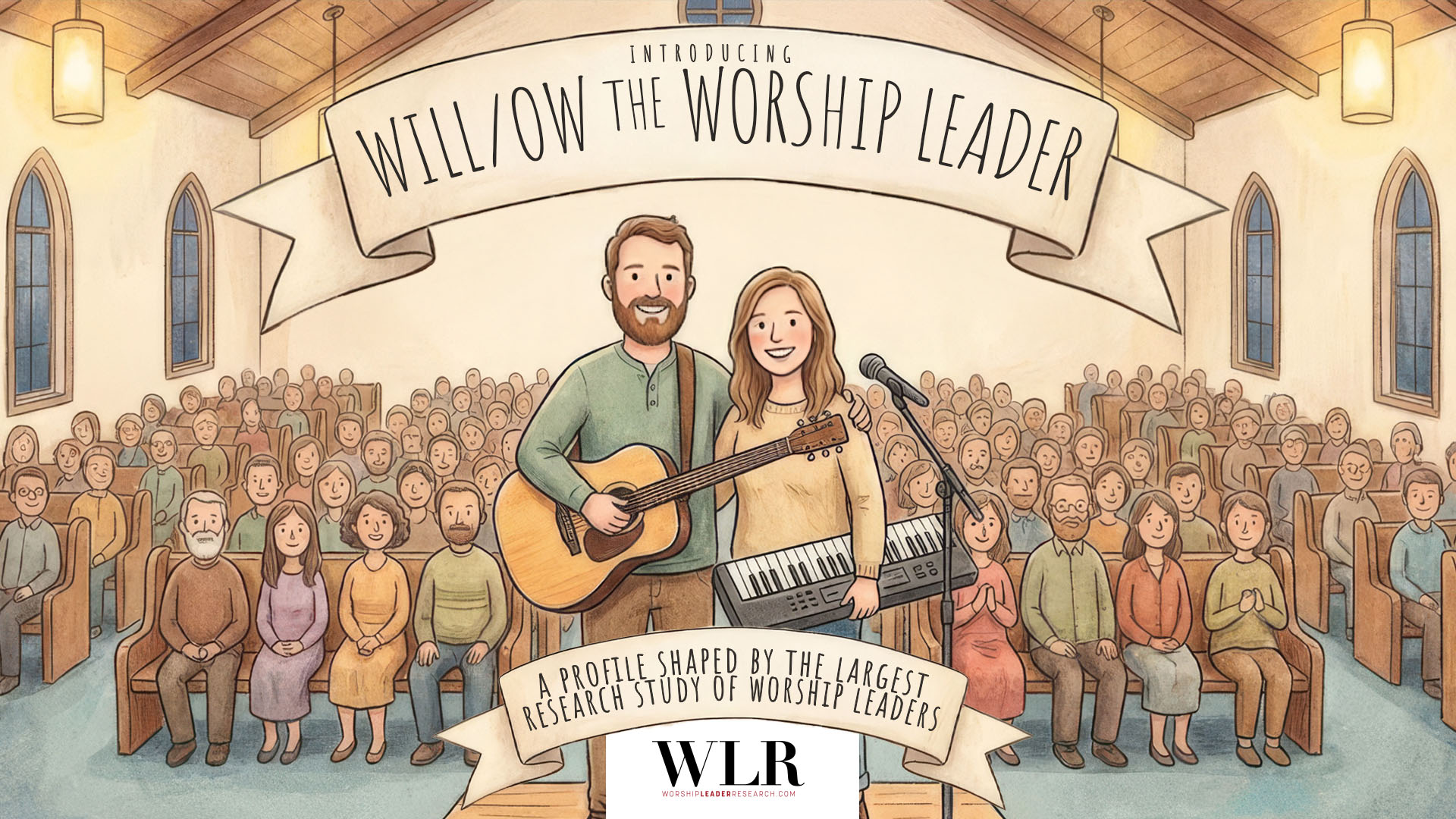
Meet Will and Willow Worship Leader.
They are composite sketches emerging from our Spring 2025 survey data. They represent the thousands of real worship leaders shaping Sunday morning worship across North America. Will and Willow aren’t particularly famous. They aren’t the visible worship artists dropping new content on Spotify and social media. It’s important to understand who they are, though, because they’re forming the spiritual lives of congregations every week.
The Full-Time Professional You’ve Never Heard Of
Here’s something that might shock you. 84% of worship leaders are employed full-time. This isn’t a side gig or volunteer position for most of them. It’s actually a career. In fact, only 5% surprisingly serve part-time, and just 5% are unpaid volunteers. (We did not collect salary information.)
While “worship leader” was a new title 40 years ago, it is now commonplace. A staggering 82% use “Worship Leader” as their title, with only 6% identifying as “Worship Pastors.” These aren’t music directors from a past era. They’re a distinct professional class that has emerged over the last generation and has been largely invisible in other national studies of church leaders.
So, Will and Willow both carry the title “worship leader” and draw full-time salaries for their work.
The Training Gap
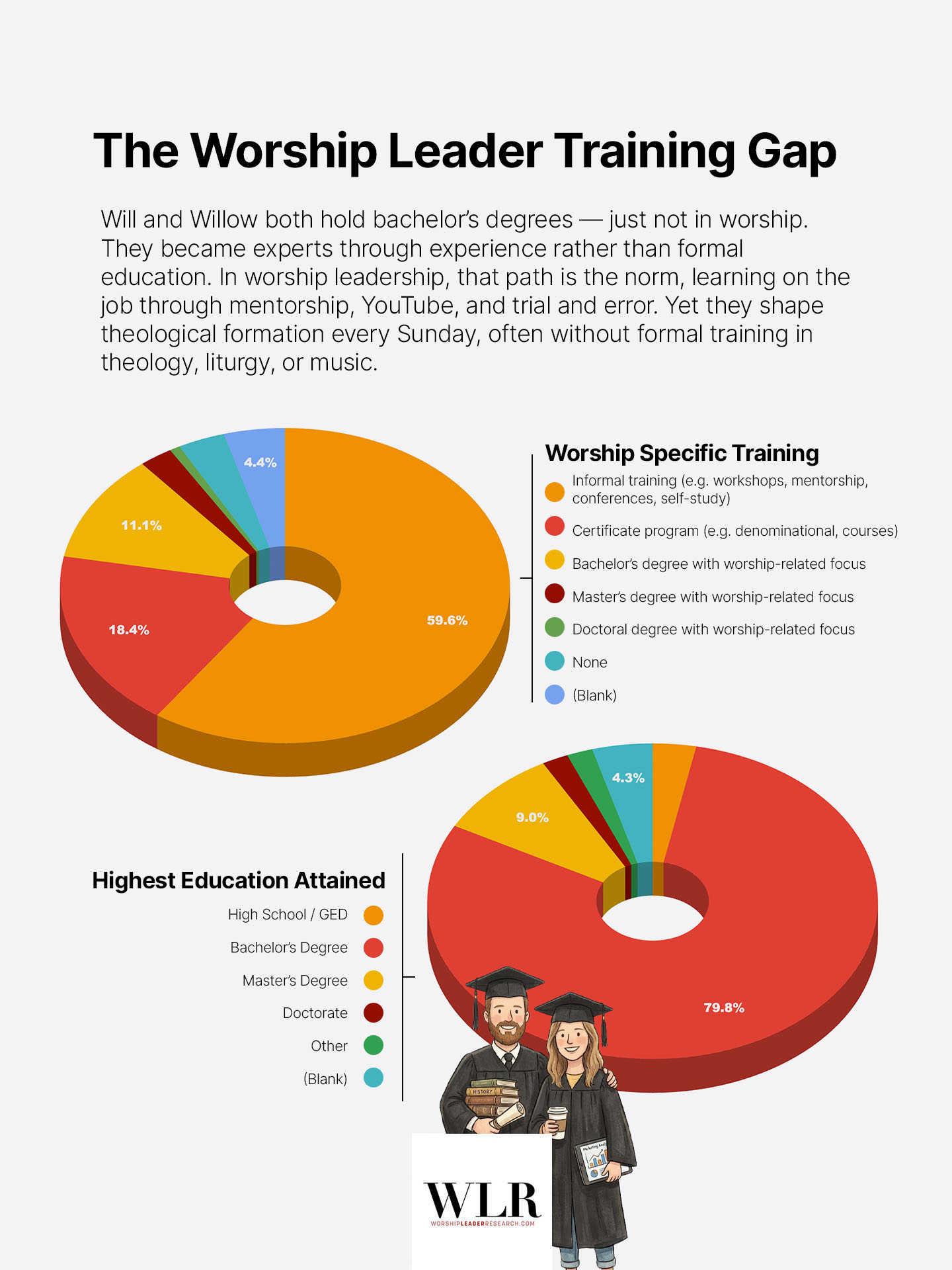
Most WLs are working without formal training in worship, and that’s considered normal.
Only 11% have a bachelor’s degree in worship studies. Just 2.4% have a worship studies master’s degree, and less than 1% have a worship studies doctorate. Meanwhile, 80% have general undergraduate degrees, but in other fields. Of note, 60% have relied on informal training, and nearly the same percentage have never pursued any accredited worship education.
This creates an unusual dynamic. Worship leaders are full-time professionals, but most have likely learned their craft on the job through mentorship, YouTube tutorials, and trial and error. We wouldn’t accept this in most professions (e.g. teachers, accountants, doctors, and therapists). Yet worship leaders shape theological formation every Sunday, often without formal training in theology, liturgy, or music theory.
What is clear is that Will and Willow both have bachelor’s degrees, just not in worship. They learned to lead through informal training and years of practice. They’re professionals who became experts through experience rather than formal education. And in worship leadership, that’s the norm.
The Gender Surprise
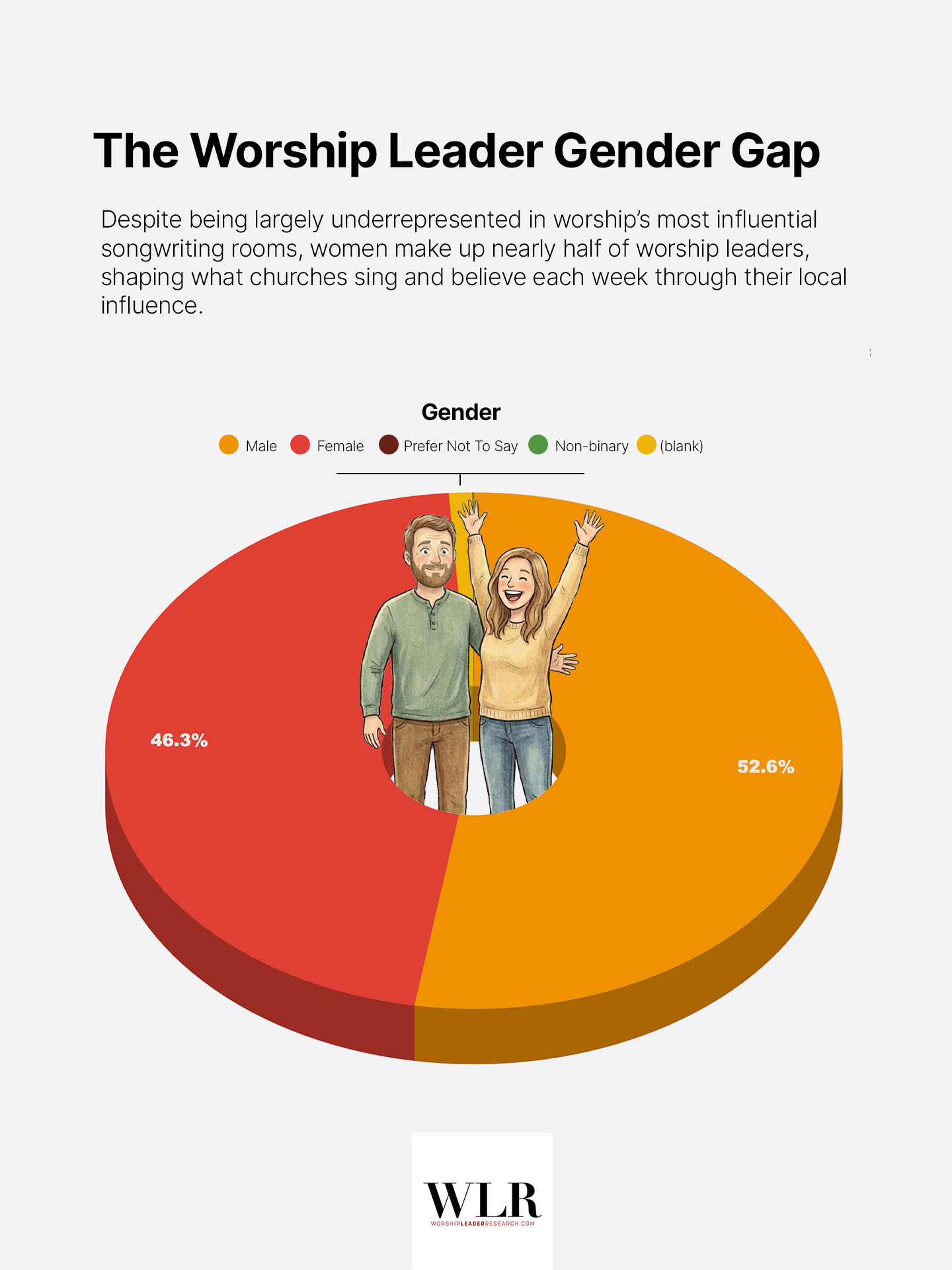
Despite the popular imagination of a worship leader as a man, the data tells a different story. Women make up 46% of worship leaders, while men represent 53% — a near-even split.
This matters because it reveals a surprising disparity. Our previous research (link) indicated that women remain largely underrepresented in songwriting rooms and recording. Yet in local churches, where people lead worship week after week, women are present in nearly equal numbers. This means women’s representation as WLs exceeds that of both senior pastoral roles and the commercial worship music industry.
Willow WL represents women whose influence is local rather than commercial, but no less significant. They’re making theological decisions every Sunday about what their churches sing and how they worship, even if they’re not writing or performing the songs that chart at the highest level.
Young, But Not That Young (and Definitely Millennial)
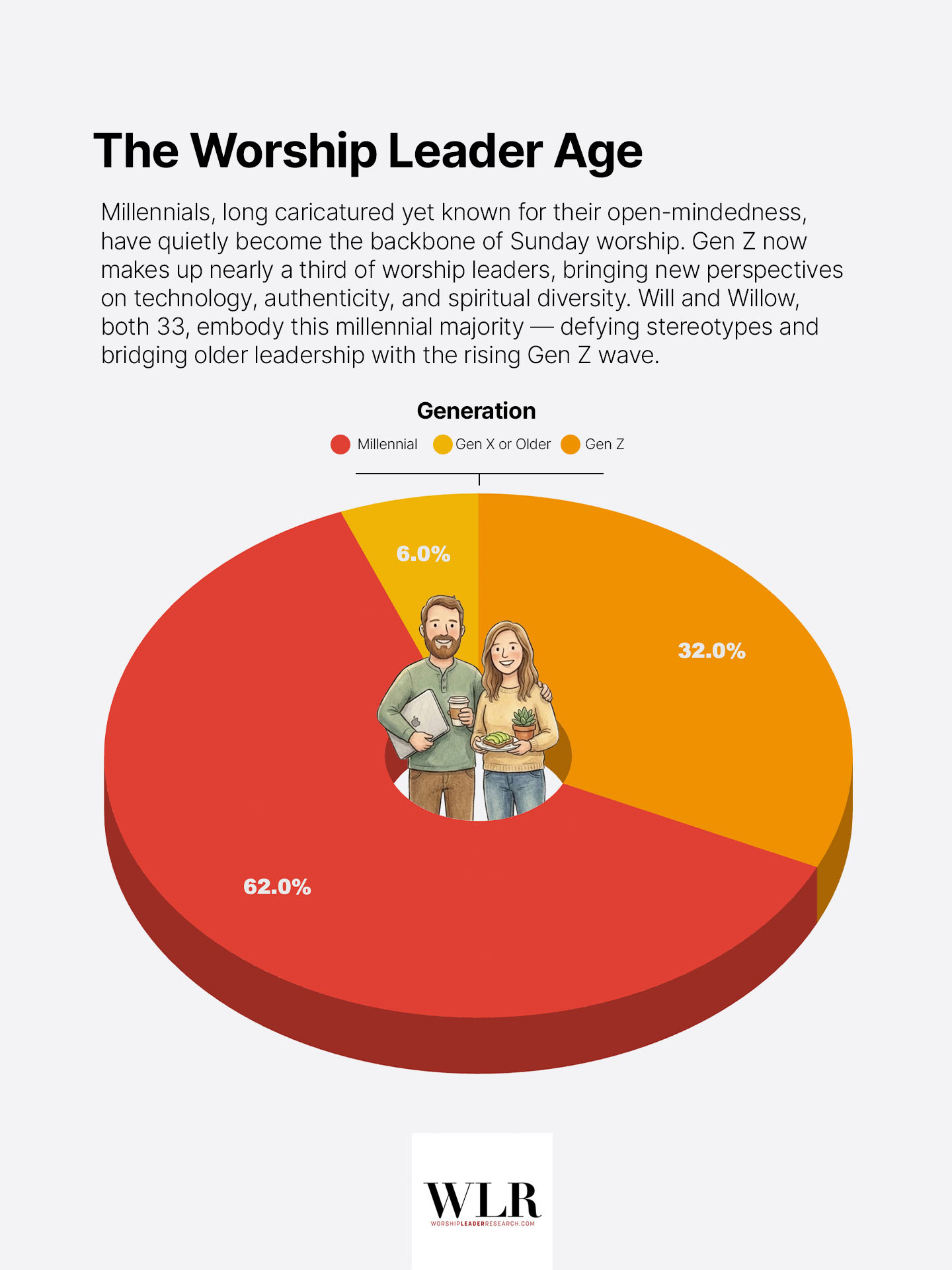
When it comes to age, unsurprisingly, worship leaders skew younger than other church leaders. The median age is 33.4, and 76% are under 40. For context, the average pastoral leader in North America is 59 years old.2See Chaves, Mark, Anna Holleman, and Joseph Roso. 2025. Clergy in America. Durham, NC: Duke University, Department of Sociology (National Survey of Religious Leaders), https://static1.squarespace.com/static/65417aab75d81771950d332f/t/67cb42e5cad1c1762527f317/1741374184941/NSRL-report-2025-clergy-in-america.pdf, pg 8.
The generational breakdown reveals who’s actually leading worship:
- Gen Z: 32%
- Millennials: 62%
- Gen X and older: 6%
Consider this. Millennials have been, on one hand, mocked (unfairly) for being lazy and materialistic and, on the other hand, noted for their flexible and open-minded worldview. Yet, they have quietly become the backbone of Sunday morning worship.
Meanwhile, Gen Z makes up nearly a third of today’s worship leaders. This younger generation is already shaping worship culture, and bringing fresh perspectives on technology, authenticity, and what it means to lead spiritually diverse congregations.
Will and Willow are both 33, solidly millennial, representing the generation that defies the stereotypes and serves as a demographic bridge between older and younger WLs.3https://www.brookings.edu/articles/millennials/
The Whiteness Factor
This may or may not be a surprise.
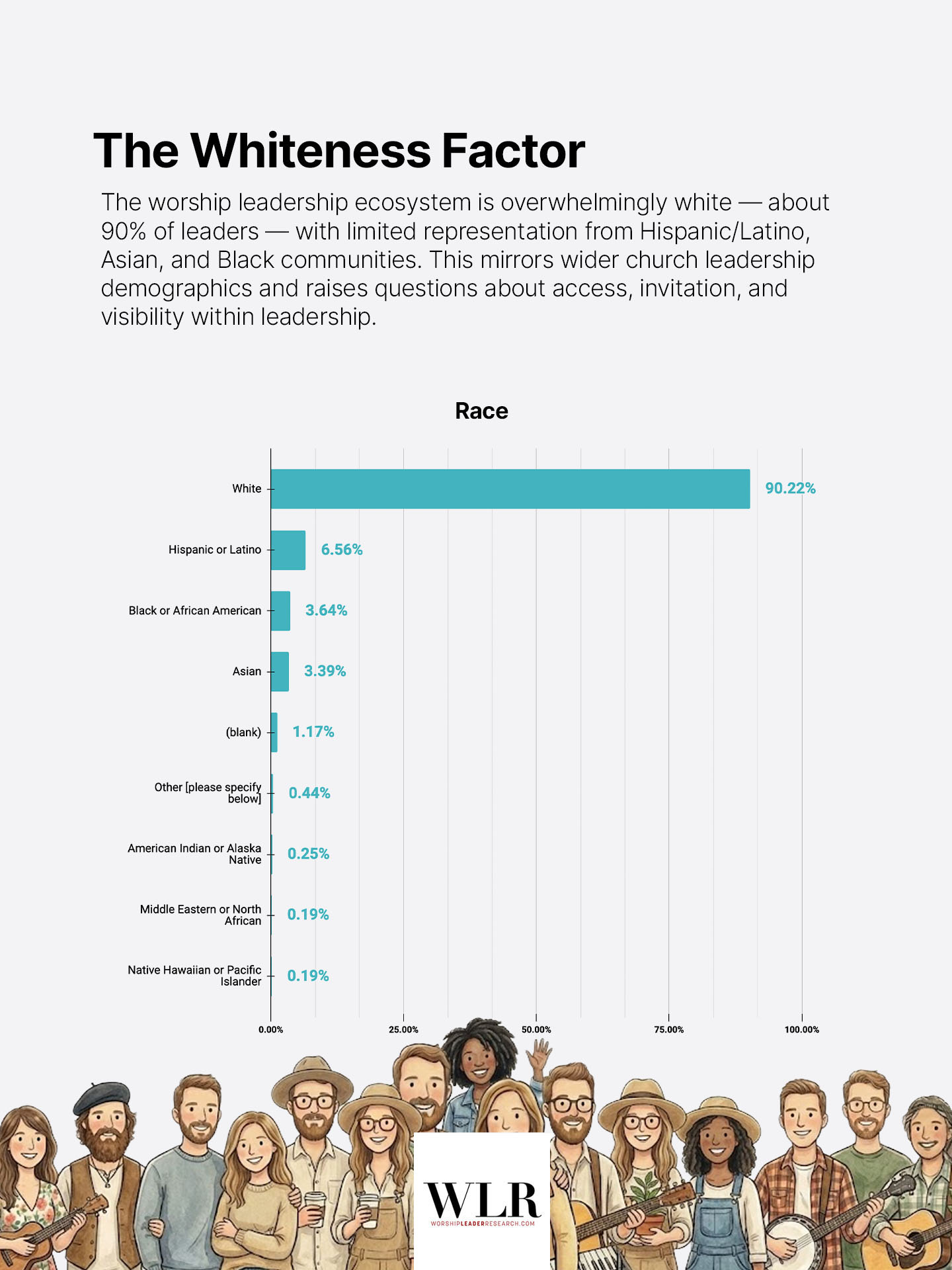
Approximately 90% of worship leaders engaged in the worship leading industry ecosystem self-identify as white. However, respondents could select one or multiple races/ethnicities — 84.4% selected white only and 5.6% selected white and one or more other options. The following numbers reflect leaders who self-selected these options alone or among multiple identifiers: Asian leaders make up 3.4%, Black or African American leaders 3.6%, and Hispanic or Latino leaders at 6.56%. 5.7% of respondents selected multiple racial/ethnic categories.4This may or may not be a surprise. Approximately 90% of worship leaders engaged in the worship leading industry ecosystem self-identify as white. However, respondents could select one or multiple races/ethnicities — 84.4% selected white only and 5.6% selected white and one or more other options. The following numbers reflect leaders who self-selected these options alone or among multiple identifiers: Asian leaders make up 3.4%, Black or African American leaders 3.6%, and Hispanic or Latino leaders at 6.56%. 5.7% of respondents selected multiple racial/ethnic categories. These numbers mirror broader patterns in church leadership, but they’re still jarring. The worship industry, with its conferences, training programs, and social media networks, remains overwhelmingly white. Whether this reflects the demographics of who’s invited into these spaces, who feels welcome, or who has access to the resources that create industry engagement are questions worth asking. What can’t be denied is that Will and Willow are both white, reflecting the broader industry’s demographic reality down to the level of local worship leadership.
These numbers mirror broader patterns in church leadership, but they’re still jarring. The worship industry, with its conferences, training programs, and social media networks, remains overwhelmingly white. Whether this reflects the demographics of who’s invited into these spaces, who feels welcome, or who has access to the resources that create industry engagement are questions worth asking.
What can’t be denied is that Will and Willow are both white, reflecting the broader industry’s demographic reality down to the level of local worship leadership.
The NON-Denomination
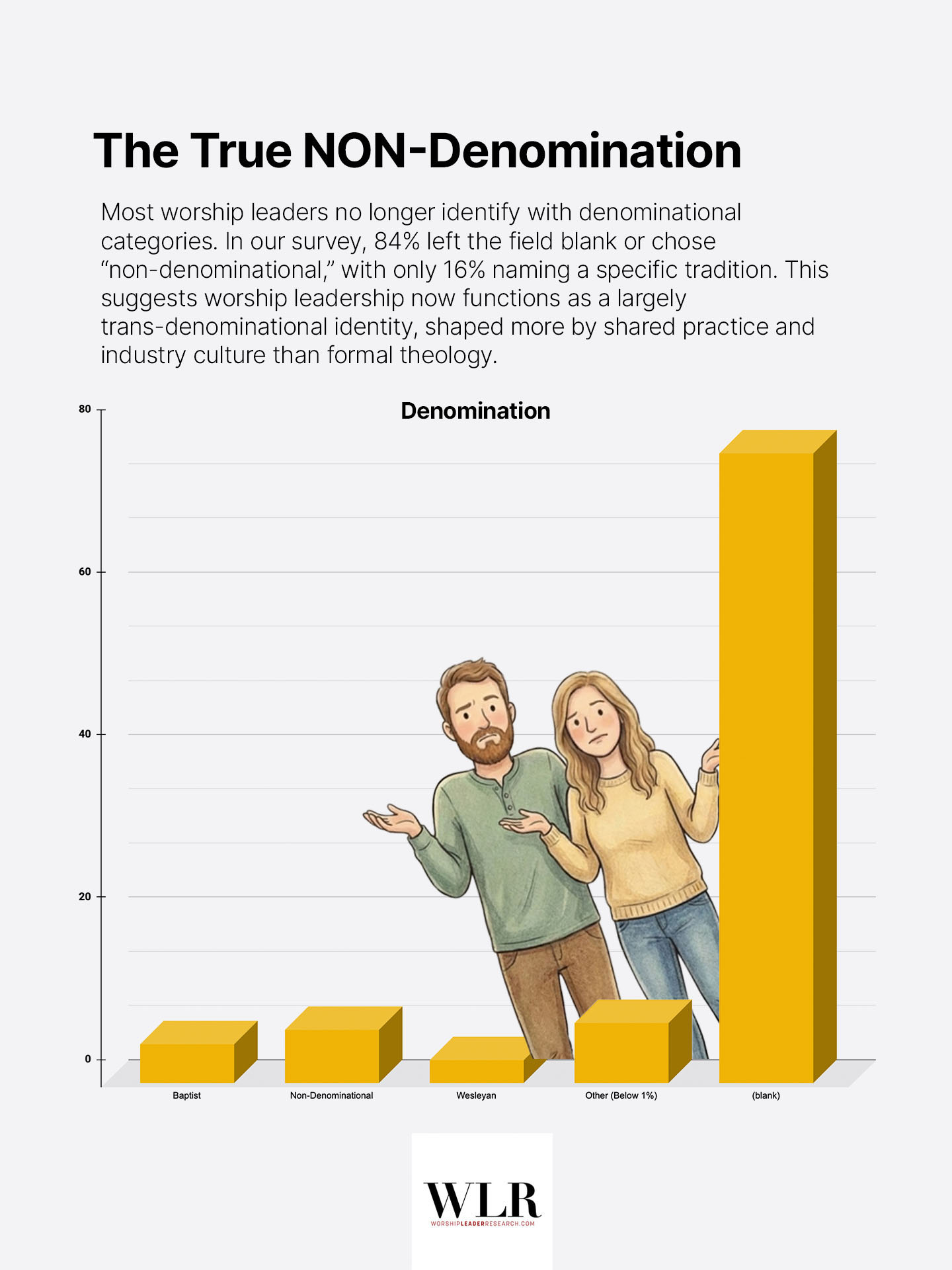
Here’s another finding that reveals something profound about the culture of contemporary worship: 77.5% of respondents left the denomination field blank. When you add those who selected “non-denominational,” it adds up to 84% of WLs.
Only 16% identified with a specific denominational tradition. Among those who did, they identified as:
- Non-denominational: 6.5% (nearly 40% of those who made a selection)
- Baptist: 4.8%
- Wesleyan: 2.8%
What does this mean? Either worship leaders belong to independent churches and didn’t think to select “non-denominational,” or (perhaps more likely) they simply don’t think of themselves through denominational lenses. Worship leadership has become its own trans-denominational identity, shaped more by shared musical practices and industry connections than by theological tradition.
Will and Willow don’t identify strongly with a denomination. They serve in churches that might functionally be Baptist or non-denominational, but that label doesn’t define how they think about their work.
Small Churches, Big Influence
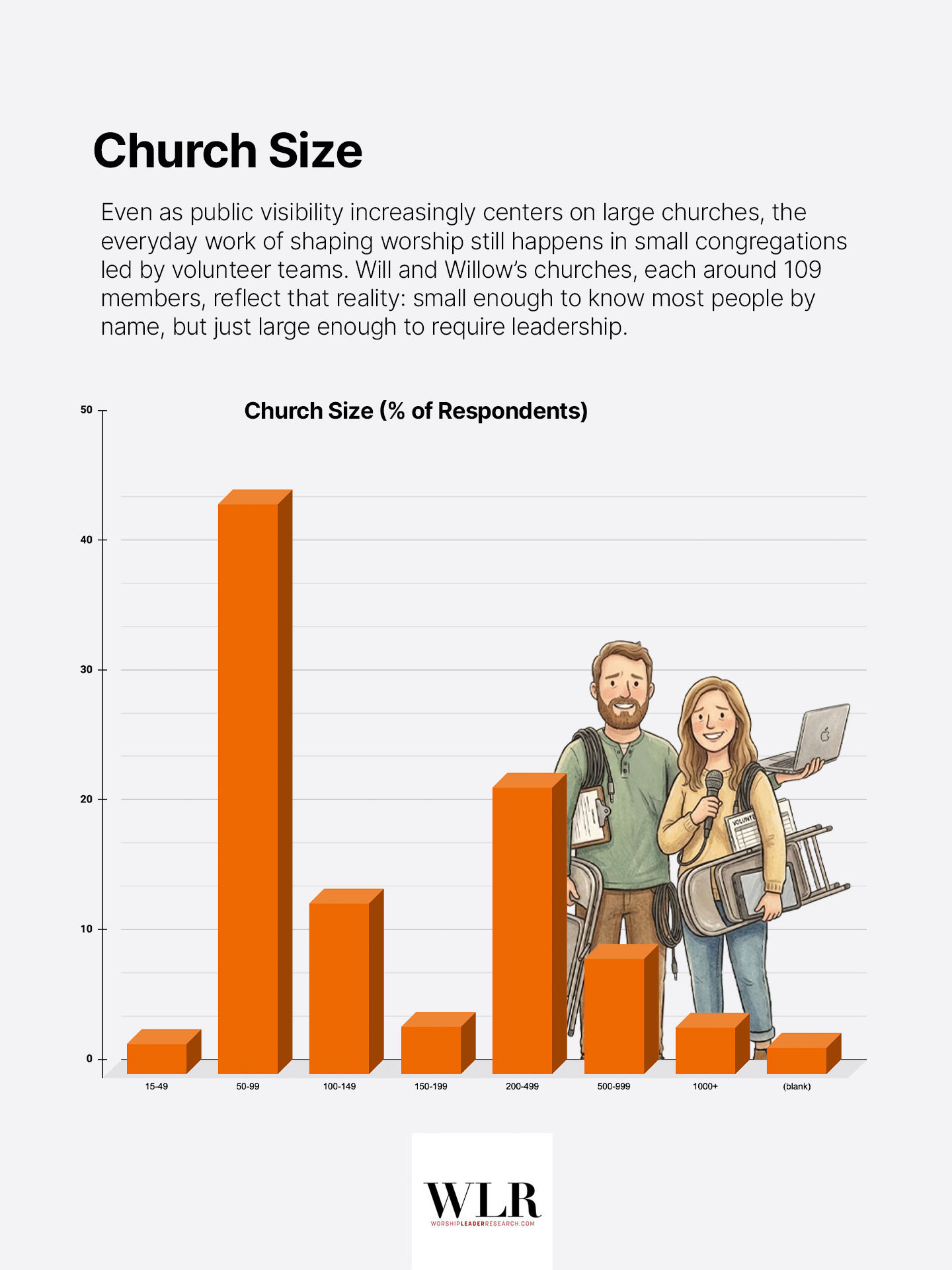
The median church size in our survey is 109 members, undeniably larger than the national median of 65, but still small by megachurch standards.5 See the National Survey of Religious Leaders, https://static1.squarespace.com/static/65417aab75d81771950d332f/t/67cb42e5cad1c1762527f317/1741374184941/NSRL-report-2025-clergy-in-america.pdf, pg 8.
The breakdown:
- 50-99 members: 44%
- 200-499 members: 22%
- 100-149 members: 13%
This makes sense mathematically. There are far more small churches than large ones, so more worship leaders are serving in them. But it raises important questions about influence and visibility. The worship leaders shaping Sunday morning for most U.S. and Canadian Christians aren’t the ones on platforms at conferences or releasing albums. They’re leading teams of volunteers in sanctuaries that serve about 100 people.
So, Will and Willow each serve churches of about 109 people. That’s small enough that they know most congregants by name, but large enough to require intentional leadership.
The Composite Portrait
So who are Will and Willow, the worship leaders?
They’re 33 years old and have been leading worship for 15 years, suggesting they started around 18. They have bachelor’s degrees, but not in worship, and maybe in business, education, or communications. They’ve learned their craft through informal training, mentorship, and experience. They’re paid full-time staff members who lead worship (perhaps among other duties) at churches of about 109 people. They’re both white. They don’t think much about denominational labels.
They’re not famous. They’re not likely to be gaining likes on Spotify for their songs. But they’re shaping the spiritual formation of their congregations every single week, and they’ve been doing it longer than you’d think.
Will and Willow Worship Leader are the face of contemporary worship in North America. Understanding them means better understanding the reality of worship leadership today.